1. The easiest way to picture it
Do not start from banking apps. In China, WeChat and Alipay come before the bank.
An easy analogy: WeChat and Alipay are cities inside a phone. Inside that city a user talks to friends, orders food, hails a taxi, books a hospital appointment, pays utility bills, buys insurance, takes out a loan, and pays for all of it.
Mini programs are the small shops inside that city. Without installing anything, a user reaches a coffee brand, a hospital, a shopping mall, a game, a government agency or a financial service directly inside WeChat or Alipay.
And NetsUnion is the national-grade clearing road every one of those payments travels along behind the scenes. The user never sees it, but transactions from non-bank payment institutions like Alipay and WeChat Pay are settled through that infrastructure.
Five lines worth holding in your head before reading on.
Users stay in the super app. Services arrive as mini programs. Payment closes inside the platform. Clearing is tidied up by national infrastructure behind it. Offline stores connect through POS and IoT terminals.
Hold that structure and it becomes visible why Chinese fintech runs differently from Western fintech.
2. Market size: from fifty billion dollars toward a hundred
The Chinese fintech market is already enormous. Mordor Intelligence values it at roughly US59.39 billion in 2026, projecting US$123.78 billion by 2031. (Mordor Intelligence)
A caution here. Fintech market size and payment transaction value are different things. Some reports give far larger numbers based on Chinese digital payment volume, but that is closer to gross amount paid, which is not the same as fintech companies’ service revenue or industry turnover.
So this piece separates “revenue-based market size of the Chinese fintech industry” from “transaction value flowing through payment infrastructure.”
Simply put:
| Term | What it means | Example |
|---|---|---|
| Fintech market size | service revenue fintech firms generate | payment fees, financial services, tech services |
| Payment transaction value | total money actually moved through platforms | QR payments, transfers, shopping, utilities |
| GMV | value of goods and services transacted on a platform | mini program shopping, food orders, tickets |
The reason the numbers get confusing is that these three often get mixed. Market size is in the tens of billions of dollars; payment transaction value is in the tens of trillions. Mini program GMV is counted differently depending on source and scope.
Which makes a more interesting question than “how big” this: through what structure does this enormous volume arise, who holds the user touchpoint, and who tidies up the flow of money behind it?
3. Super apps: the entrance where users stay
The first axis is the super app: WeChat and Alipay.
WeChat started as a messenger. It is not a chat app now. Messages, groups, official accounts, mini programs, shopping, games, transfers, payments and daily services are all connected into an enormous life platform.
Alipay started from payments. It is now closer to financial and living infrastructure connecting finance, insurance, lending, investment, public services, transit and local services.
The difference, briefly:
| Alipay | ||
|---|---|---|
| Origin | messenger, social relationships | payments, finance |
| Strength | conversation, groups, social commerce, mini programs | payments, financial services, daily and public services |
| User behaviour | discovers while chatting, then buys | comes in with a relatively clear purpose |
| Data asset | relationships, conversational context, sharing, community | transactions, credit, financial behaviour, everyday payments |
| Fintech meaning | the touchpoint where users stay | the touchpoint where money moves |
A Chinese user does not have to open a banking app to use financial services. They pay, transfer, collect coupons, apply for loans and check insurance inside the WeChat or Alipay they already use daily.
That is the starting point of Chinese fintech.
4. Mini programs: a service economy without app installs
The second axis is the mini program, an app inside an app.
To order coffee, a user elsewhere might open a coffee chain app, a delivery app, a maps app and a payment app. A Chinese user opens the brand’s mini program inside WeChat, picks a menu item, applies a coupon and pays with WeChat Pay. No installation.
The structure matters because it reduces drop-off.
App install, sign-up, login and payment method registration are all friction. Mini programs cut that friction. The user is already logged into the super app and their payment method is already connected. Sharing with a friend is easy.
A typical flow inside WeChat:
- A friend shares a restaurant’s mini program link in a group chat.
- The user taps it.
- The menu opens with no app installed.
- They apply a coupon.
- They pay with WeChat Pay.
- They return to the group chat.
This differs from the traditional app economy. The user does not search an app store. The service is discovered, used and paid for inside the super app.
Alipay mini programs work similarly with different strengths. Where WeChat mini programs are strong in social relationships, sharing, commerce and games, Alipay mini programs are strong in payments, public services, daily services and finance: transit card top-ups, utility bills, hospital bookings, tax services, local government services.
| WeChat mini programs | Alipay mini programs | |
|---|---|---|
| Core context | conversation, sharing, relationships | payments, finance, daily services |
| Strong areas | social commerce, games, brand communities | public services, local services, financial services |
| User flow | enters mid-conversation | enters with a purpose |
| Fintech meaning | relationship-driven conversion | intent-driven conversion |
Mini programs matter in Chinese fintech because a user never has to go somewhere separate “to use a financial service.” In the traditional structure, shopping happens in a shopping app, payment through a card or bank app, and loans or insurance in yet another financial app. Service and finance are separated.
In the Chinese mini program ecosystem, service and finance connect into one flow. Order food and payment follows immediately; shop and coupons, points and instalments come along; sell as a merchant and settlement services and working capital loans connect naturally. The user never goes looking for a financial service, and yet uses financial functions all through the service.
Which makes the point less “how well you build a finance app” and more how smoothly you slot payment, lending, insurance and settlement into behaviour people already have. Chinese embedded finance is a long way ahead on that axis.
5. The three layers on one page
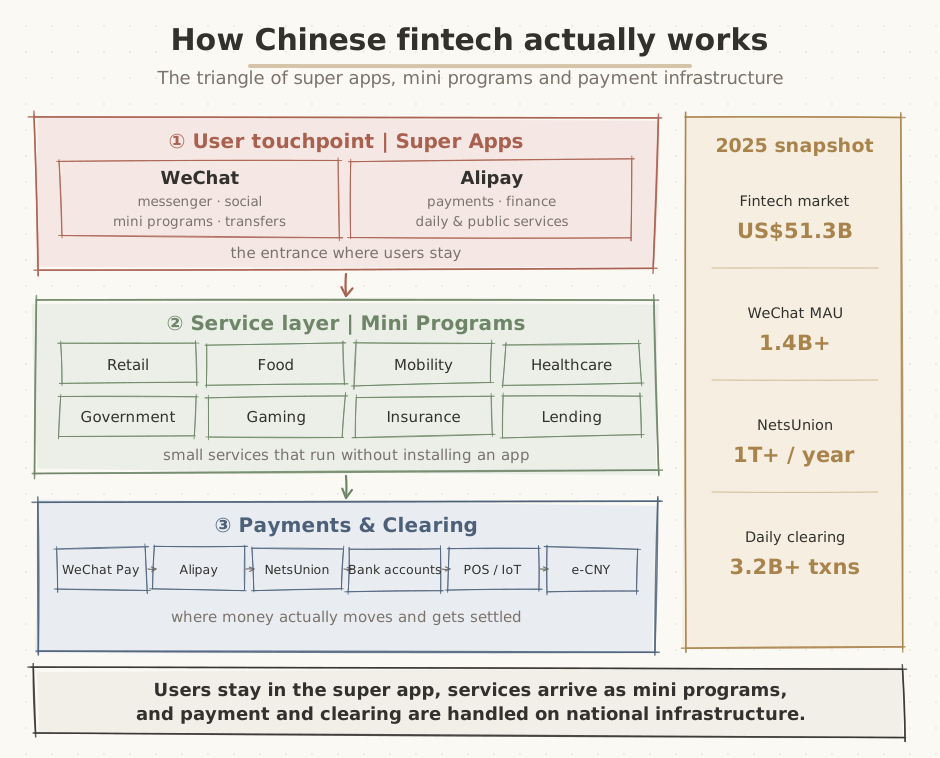
Users stay in the super app at the top; mini programs fill the execution layer in the middle with retail, mobility, healthcare and government services; and the payments and clearing layer at the bottom (WeChat Pay, Alipay, NetsUnion, bank accounts, POS/IoT, e-CNY) tidies up the flow.
6. NetsUnion: the invisible payment highway
The third axis is payment and clearing infrastructure, and one of the most important names there is NetsUnion.
NetsUnion (网联清算) is an online payment clearing platform. It was established in 2017 with People’s Bank of China approval and centrally clears transactions from non-bank payment institutions such as Alipay and WeChat Pay.
To the user, NetsUnion is invisible. They pay ¥10 at a convenience store with WeChat Pay and it feels finished. A great deal more happens behind it.
- The user scans a QR.
- WeChat Pay processes the payment request.
- The merchant’s payment institution and bank account details are verified.
- The transaction is cleared through NetsUnion.
- Money finally settles into the merchant’s account.
On the surface a one-second QR payment; behind it the user, the merchant, the payment platform, banks and clearing infrastructure all moving together.
Large payment platforms once connected directly to banks, building enormous closed payment networks. Chinese authorities did not leave that structure in place. They created NetsUnion to clear non-bank payment institution transactions centrally, making platform payment flows more standardised and supervisable.
Put simply, NetsUnion is the backend highway of Chinese mobile payments. WeChat and Alipay are the frontend the user sees; NetsUnion is the clearing infrastructure tidying transactions up behind them.
In 2025 NetsUnion processed roughly 1.1949 trillion transactions worth about ¥598.23 trillion, more than 3.274 billion transactions a day on average. The figure shows how deeply mobile payment has entered daily life in China. (人民日报 财经)
Comparing it to Visa or Mastercard as “who is bigger” is best avoided, though. Visa and Mastercard are global card networks; NetsUnion is infrastructure clearing domestic non-bank payment institution transactions. Different roles, different transaction structures. What matters is not superiority but the difference in model.
Western card networks developed around private networks. China put enormous platform payments inside national-grade clearing infrastructure. That difference produces the distinctive shape of Chinese fintech.
7. POS and IoT: payment leaves the checkout counter
Chinese fintech is not explained by phone apps alone. Terminals in offline stores are evolving fast too.
POS and IoT payments do not simply mean more card terminals. In Chinese offline retail, terminals now extend to QR scanners, self-order kiosks, facial recognition payment devices, unmanned convenience store terminals, EV chargers, vending machines, parking payment machines and bus and metro gates.
Payment no longer happens only at the counter.
It attaches when you order at the table. It attaches when you charge an EV. It attaches when you leave a car park. It attaches when you pass a metro gate. It attaches when you choose an item in a vending machine.
This is the digitisation of the offline world.
Offline payment used to centre on the checkout. You picked goods, walked to the counter, staff entered the amount, you paid with card or cash. Chinese offline payment is increasingly moving inside the service flow.
At a restaurant you scan the QR on the table to order and pay, reducing the need for staff to take orders. Car parks connect plate recognition to mobile payment. EV chargers bill automatically by usage. Unmanned stores combine product recognition, payment and access control.
Here the POS becomes a data collection point rather than a terminal. Data accumulates on what sold when, which customer used which coupon, which region’s sales are rising and at which hours payments cluster.
That data connects back to finance. Loan limits can be set from a small merchant’s sales flow, working capital provided based on inventory turnover, fraud detection models built from payment data.
Chinese fintech is strong because online and offline are not separated. Super apps, mini programs, QR payments, POS and IoT terminals connect into one payment data flow. The POS and IoT terminal segment is cited as one of the fastest-growing axes of the Chinese fintech market through 2031. (Mordor Intelligence)
8. User behaviour in the mini program economy
Mini programs are not only a technical structure. User behaviour differs too.
A native app has to be downloaded. Install, sign up, log in, allow notifications, register a payment method. Many users drop out along the way.
A mini program has a low entry barrier. Tap a link a friend shared, scan a QR, or search inside WeChat or Alipay and it opens.
The structure is particularly strong in four situations.
First, low-frequency services. For hospital bookings, government paperwork, tourist tickets or event registration, installing an app for something you rarely use feels heavy. Mini programs suit those.
Second, small repeated payments. Coffee, snacks, transit, household goods: small amounts occurring often.
Third, share-driven purchases. A link from a friend, a group buy, a brand community, live commerce.
Fourth, offline store integration. Scanning a store QR to open a menu, order and pay is the flagship mini program use case.
Seen this way, mini programs are less a technology replacing apps than a structure reducing friction in service discovery and payment.
That friction reduction is the important thing. Finance does not obstruct user behaviour; it attaches quietly inside the flow of using a service.
9. WeChat vs Alipay: same super app, different DNA
Both are super apps with different DNA.
WeChat’s essence is relationships. Users chat with friends, share in groups, read official accounts, tap mini program links. Payment attaches inside that relational flow: tap a restaurant a friend recommended, join a group buy, collect a coupon from a brand community, pay immediately.
Alipay’s essence is payment and finance. Users open it for payments, transfers, utility bills, loans, insurance, credit scores, transit and public services. The purpose is clearer and connects more readily to financial services.
The difference shapes data strategy too. WeChat knows relationships and context. Alipay knows transactions and financial behaviour. WeChat is strong on who you are connected to; Alipay on what flows of money you create.
The difference could matter when combined with agents. WeChat can capture intent inside conversation and relationships; Alipay can hold the advantage at the payment and financial execution stage.
10. Neobanking and embedded finance
In the West, embedded finance usually means attaching payment, lending and insurance inside a shopping platform, SaaS product or mobility app, such as merchant lending inside Shopify or instant payout accounts for Uber drivers.
In China this went earlier and further.
Users open WeChat or Alipay and handle shopping, transfers, insurance, loans, investment, tax payment, hospital bookings and transit payments inside. This goes beyond finance entering a particular service: the whole of daily services moved inside the super app, and finance attached naturally within it.
Chinese neobanking connects to that structure. Digital banks like WeBank provide financial services connected to enormous platform ecosystems, letting payment, transaction, consumption and business activity data feed into financial services.
The structure matters in SME finance too. Traditional banks assessed loans on collateral and financial statements. Platform-based fintech can use real-time data: sales flow, payment data, order data, customer reviews, inventory turnover.
The structure is not purely good, of course. A platform holding too much data raises questions of privacy, competition, financial risk and platform dependency. So China grew super-app fintech on one hand while making platform money flows more controllable through state-led infrastructure like NetsUnion and e-CNY on the other.
Chinese embedded finance, then, is not simply finance entering a service. Daily services themselves are inside the super app, finance attaches naturally throughout, and the clearing and monetary infrastructure behind it is held one step more firmly by the state. That is where Western embedded finance and Chinese fintech diverge.
11. The model’s strengths and risks
The strengths are clear.
First, high convenience. Users handle a great deal inside one super app without moving between apps.
Second, high conversion. Discovery, ordering, payment and sharing happen inside the same app, so drop-off falls.
Third, strong data connectivity. Conversation, search, shopping, payment, location and service usage data connect inside the platform.
Fourth, fast offline expansion. QR codes, POS and IoT terminals turn offline stores into a digital payment network.
Fifth, easy policy execution. Government coupons, consumption stimulus, public services and e-CNY can be connected to platforms and payment infrastructure.
The risks are real too.
First, platform concentration. User touchpoints concentrate in a few platforms.
Second, data privacy. The more life data and financial data combine, the more privacy protection matters.
Third, possible contagion of financial risk. When payment, lending, investment and insurance connect inside a platform, a problem in one area can spread.
Fourth, tension between state control and private innovation. China uses private platform innovation while trying to control clearing and monetary infrastructure centrally. That balance will remain a live issue.
So it is hard to cut the Chinese model cleanly as “ahead” or “dangerous.” It is closer to the truth to see it as a model where a powerful user experience and strongly centralised infrastructure are bound into one thing.
12. Chinese fintech is an operating system, not an app
The core is not that payment is fast. It is that payment sits deep inside the flow of a user’s life.
WeChat and Alipay are the entrance where users stay. Mini programs are the service layer executing inside. NetsUnion is clearing infrastructure tidying transactions where nobody sees. POS and IoT terminals turn offline space into a digital payment network.
The structure differs from Western fintech, where banks, card networks, fintech apps and commerce platforms developed relatively separately. In China the super app bound communication, commerce, payment, finance and public services into one user experience.
The model will not repeat identically everywhere. China had particular conditions: an enormous domestic market, powerful platform operators, state-led clearing infrastructure, rapid mobile payment adoption.
Still, the reason the case matters is clear. The future of finance does not necessarily come only from a better banking app. When payment and finance enter naturally where users already are, fintech stops being a separate app and becomes living infrastructure.
On that reading, Chinese fintech is less the result of moving the bank onto a phone than the result of slotting one more layer of finance on top of a living operating system inside the phone.
Keywords
Super App, Mini Program, WeChat Mini Program, Alipay Mini Program, NetsUnion, POS IoT, China Fintech Market, Embedded Finance, Neobanking, Digital Payment Infrastructure
References
- China Fintech Market Size, Industry Growth, Analysis & Forecast (Mordor Intelligence)
- China POS Terminals Market Size & Share Outlook to 2031 (Mordor Intelligence)
- 2025年我国支付系统共处理支付业务12807.07万亿元 (人民日报 财经)
- Tencent 2025 Annual Report (PDF)
Written as of 26 May 2026 from public reporting and company and government material. Market size and growth are estimates from research firms such as Mordor Intelligence and may differ from official statistics. Mini program GMV and user counts are aggregated differently by source, so treat them as reference for understanding the structure rather than as precise figures.
Related posts: