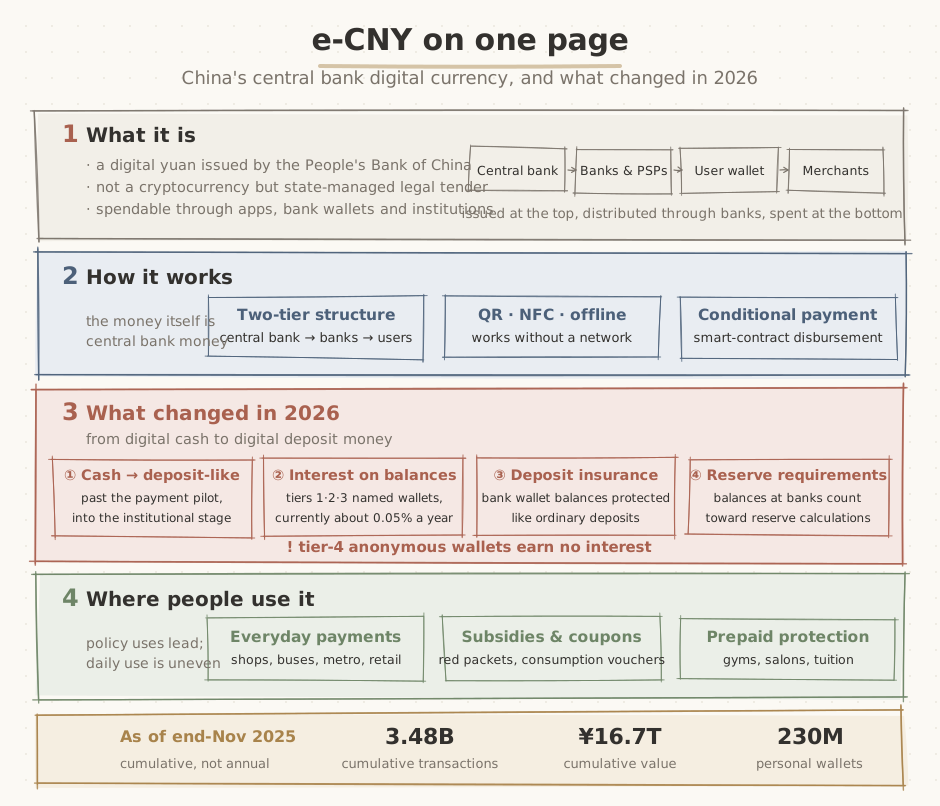
The whole structure summarised on one page: what it is, how it works, what changed in 2026, where it gets used, and the headline numbers. (Sources: People’s Bank of China, Xinhua, public reporting, Nov 2025 to May 2026)
1. Why e-CNY now?
China’s digital yuan is a flagship central bank digital currency project piloted since 2019. The original concept was relatively simple: digital cash replacing notes and coins in digital form. e-CNY was designed closer to central bank money (M0) than to commercial bank deposits.
Over time the structure showed its limits. China’s everyday payment market was already held by Alipay and WeChat Pay. Users had little strong reason to install a new e-CNY app, create a wallet and top it up. They used it when there were government subsidies, consumption coupons or red packets, and drifted back to their existing payment apps otherwise.
The new management framework announced at the end of 2025 is closer to a change of direction to solve that. The People’s Bank of China put a new e-CNY management and operating framework into effect on 1 January 2026, and named commercial bank e-CNY wallet balances began earning interest. People’s Daily described the change as entering “the era of digital deposit money from the era of digital cash.” (人民日报)
So e-CNY no longer stops at spendable digital cash. Held in a bank wallet it now earns interest, receives deposit insurance protection, and enters reserve requirement calculations.
2. What changed on 1 January 2026
Four things.
First, named e-CNY wallet balances earn interest. From 1 January 2026 major operating institutions pay interest on named digital yuan wallet balances at each bank’s demand deposit rate. According to 21st Century Business Herald, tier 1, 2 and 3 named wallets are eligible; tier 4 anonymous wallets, openable with a phone number alone, are not. Major banks’ demand deposit rate is currently around 0.05% a year. (21世纪经济报道)
Second, e-CNY in a commercial bank wallet is treated as a bank liability. PBOC deputy governor Lu Lei explained that under the new framework, e-CNY a customer holds in a commercial bank wallet is treated as an account-based commercial bank liability. That means e-CNY moving from a central-bank cash structure to a commercial-bank deposit structure. (人民日报)
Third, it receives deposit insurance protection. Under the new framework, e-CNY balances in bank wallets receive the same level of deposit insurance protection as ordinary deposits. That signals to users that this is money protected inside the banking system, not app points. (人民日报)
Fourth, it enters reserve requirements. e-CNY wallet balances operated by banks count toward reserve requirement calculations, while e-CNY managed by non-bank payment institutions requires 100% reserves. This puts e-CNY inside the financial system’s asset and liability management rather than treating it as a payment instrument. (新华社)
To be clear, this is not a story about e-CNY suddenly becoming a high-yield product. 0.05% a year is very low. What matters is not the rate but that e-CNY’s institutional position changed.
3. The scale, in numbers
According to PBOC material, cumulative e-CNY figures as of end-November 2025:
| Metric | Figure | As of |
|---|---|---|
| Cumulative transactions | 3.48 billion | end-Nov 2025 |
| Cumulative transaction value | ¥16.7 trillion | end-Nov 2025 |
| Personal wallets | 230 million | end-Nov 2025 |
| Corporate/institutional wallets | 18.84 million | end-Nov 2025 |
On those numbers alone, e-CNY can look like it has arrived at the centre of Chinese payments. A caution: these are cumulative figures, the total including government subsidies, public service payments, corporate and institutional transactions and various test transactions across the pilot period. (新华社)
Reuters reported that while cumulative e-CNY transaction value stood at ¥16.7 trillion as of end-November 2025, total Chinese payment volume ran to about ¥128 trillion in 2025 alone. (Reuters) The PBOC’s own figure for 2025 is far larger: its payment systems processed ¥12,807 trillion. (人民网) On either measure e-CNY’s share is small. So e-CNY has grown to a meaningful scale, but reading that directly as having replaced Alipay and WeChat Pay is not supportable.
Regional differences are sharper. Fuzhou reported e-CNY transaction value of ¥384.189 billion as of March 2025, with 7.7916 million personal wallets and 536,700 merchants accepting e-CNY. (福州日报) Jiangsu is larger still: cumulative transaction value of ¥15 trillion at end-2025, consumption of ¥176.9 billion, 78.05 million wallets and 4.04 million accepting merchants. (新浪财经)
Even here, voluntary daily use and policy-driven use have to be distinguished. Large transaction value and users genuinely preferring it are not the same claim.
4. How do people actually use it?
Understanding e-CNY takes more than the institutional change. It takes looking at why people use it, when they do not, and where they find it useful.
So I went through Chinese local reporting and user reactions. The picture is fairly mixed. On one side there is a “I’m used to it now” experience; on the other, a blunt “I don’t bother unless there’s a promotion.”
4.1 Curiosity first, everyday use in some regions
Fuzhou reporting includes a case describing a consumer who first tried e-CNY out of curiosity and afterwards came to choose it naturally at supermarkets, on buses and on the metro. That user positively mentioned the speed of payment, the reassurance of legal tender status, and expectations around information protection. (福州新闻)
Not over-reading a single case matters here. One user’s experience does not represent national habits. But it does show that in regions like Fuzhou, where e-CNY is connected to the metro, buses, commercial districts, e-commerce platforms and public services, it is moving from a payment method you try to a payment method you can use.
Fuzhou reporting describes e-CNY payments and discount events running at major tourist areas and commercial districts and on living-service platforms. So it is more accurate to see people using e-CNY as the result of usable locations combined with discount incentives rather than pure technical curiosity.
4.2 The reality: “nobody uses it without a promotion”
The weakness is equally clear. In January 2025 Securities Times reported that e-CNY sat in the awkward position of having no users when no campaign was running. On-the-ground reporting mentioned cases where even some bank staff did not know wallet tiers or payment functions accurately, and users sometimes found e-CNY less convenient than existing methods. (证券时报)
This is the important point. e-CNY is a technically interesting project, but from a Chinese user’s perspective Alipay and WeChat Pay are already convenient enough. For a new payment method to succeed it has to go past “technically possible” to “a reason to change an existing habit.”
The 2026 interest policy can be read as an attempt to patch exactly that weakness. The interest is not large, but it carries a message: money that earned nothing sitting in a wallet now earns at least a little, like a bank deposit.
4.3 Small interest, large institutional signal
After the January 2026 update, named wallet balances earn interest at bank demand deposit rates, currently around 0.05% a year at major banks, so the monetary incentive itself is small. ¥100,000 earns about ¥50 a year; ¥1 million about ¥500. (21世纪经济报道)
Psychologically, though, the change may matter. Money left in an e-CNY wallet previously earned nothing, like holding cash. Now, held in a named wallet, it takes on a character close to a bank deposit. Users can come to see e-CNY as a wallet that costs less to hold rather than one to empty quickly.
That interest is limited to named wallets also matters. Tier 4 anonymous wallets earn none, a design balancing user convenience against anti-money-laundering and identity-based financial management.
4.4 The difference from existing payment methods is still vague
Early user experience produced many reactions that e-CNY is not much different from Alipay or WeChat Pay. Looking at QR or app-based payment alone, a user feels little difference. e-CNY’s actual differentiators are not the screen UX but what sits behind it: legal tender status, immediate settlement, offline payment capability, and smart-contract conditional disbursement.
Which also means mass adoption is not easy. Ordinary users care less about reserve requirements or monetary tiers than about where it is convenient, whether there is a discount, and whether refunds are easy. For e-CNY to be used widely in everyday payments, user utility has to become clearer than policy meaning.
4.5 Dual offline payment is meaningful as a complement
One of e-CNY’s technical differentiators is dual offline payment, which allows payment under certain conditions when neither payer nor payee is connected to a network.
Local reporting and early pilot cases repeatedly note that e-CNY’s offline payment can be useful in unstable network environments, on metros and buses, and at large events. Even here it is better understood as a function complementing existing mobile payment in particular environments than as replacing all payment.
So e-CNY’s strength shows less in revolutionising buying coffee at a café than in areas where existing payment networks are unstable or where policy and public purposes are strong.
4.6 Smart contracts are producing real cases in prepaid funds
Another important function is smart contracts, with strong potential in prepaid consumption such as gyms, salons, education providers and shopping cards, where you pay first and receive service later.
Merchants taking prepayments and then closing or absconding has been a recurring problem in China. e-CNY smart contracts can handle this through conditional disbursement. Even when a user pays up front, the money does not all pass to the merchant at once; it can be designed so that portions are released as service is actually provided.
21st Century Business Herald described the e-CNY smart-contract-based 元管家 product being used in prepaid consumption areas including education, fitness, beauty, shopping and dining, and introduced cases where unused prepaid funds were refunded along their original path after some gyms closed. (21世纪经济报道)
This is one of e-CNY’s most realistic use cases. In ordinary QR payment the difference from Alipay and WeChat Pay is small; in areas where the conditions on how money is used must be managed, e-CNY has a clear differentiator.
5. Alipay and WeChat Pay are being redefined, not disappearing
e-CNY growing does not immediately remove Alipay and WeChat Pay. In the current structure they are being absorbed as major distribution channels for e-CNY.
Public reporting as of January 2026 names ICBC, ABC, Bank of China, CCB, Bank of Communications, Postal Savings Bank, China Merchants Bank and Industrial Bank as e-CNY operating institutions, along with MYbank (connected to Alipay) and WeBank (connected to WeChat Pay). (新浪财经)
The structure looks like a distinctly Chinese compromise. Rather than the central bank providing wallets to every user directly, e-CNY is distributed through commercial banks and the existing payment ecosystem. And yet bank wallet balances are managed as deposit-like liabilities, and non-bank payment institutions face strict near-100% reserve requirements.
So the spread of e-CNY is better read as national monetary infrastructure going deeper as the underlying rail beneath private payment platforms than as the state replacing Alipay and WeChat Pay. PIIE likewise analysed the 2026 change as moving e-CNY closer to ordinary deposits or digital wallet balances rather than overturning the existing balance between banks and fintech platforms. (PIIE)
6. Where programmable money meets AI payments
The interesting part of e-CNY becoming digital deposit money is programmable money.
e-CNY has already experimented with smart-contract conditional disbursement, such as making a government subsidy spendable only in certain sectors or releasing prepaid funds to a merchant only when service is actually used. In 2022 Chinese authorities described e-CNY smart contracts as contributing to the digital economy, business environment and digital governance. (State Council of China)
Connect it to AI payments and a more interesting picture appears. You can imagine a user telling an agent to pay only for services meeting certain conditions, with an e-CNY smart contract releasing funds according to whether those conditions were met.
The user delegates service conditions to an AI. The AI finds a suitable provider. An e-CNY smart contract locks payment conditionally. Funds release automatically once the service is delivered. If conditions are not met, the balance stays with the user.
This part is still closer to possibility. As of May 2026 it is hard to confirm large-scale commercial cases where e-CNY smart contracts are seriously combined with consumer-facing agent payments. So it is safer to treat it as a technical junction that could connect rather than something that has already happened.
7. How this differs from global CBDC debate
China’s shift is interesting against global CBDC discussions.
The European Central Bank says that just as a cash wallet earns no interest, digital euro holdings will not be remunerated. The ECB’s position is closer to designing the digital euro as a digital complement to cash rather than a competitor to deposits. (European Central Bank)
The Federal Reserve likewise warned in its 2022 CBDC discussion paper that a CBDC replacing commercial bank deposits could affect the banking system’s deposit base and credit supply. Concerns have been raised in particular that an interest-bearing CBDC could pull funds out of bank deposits and low-risk assets such as money market funds. (Federal Reserve)
In that context China’s choice is distinctive. Rather than building e-CNY as a structure where the central bank absorbs all deposits directly, China folded it into commercial bank liabilities, deposit insurance and reserve requirements. Instead of leaving the CBDC outside the banking system as a competitor, it institutionalised it inside.
That does not mean China found the right answer. It is closer to an experiment in solving the concerns other countries have raised (deposit flight, privacy, monetary policy transmission, the relationship with private payment platforms) through Chinese-style institutional design.
8. Privacy and data: the strength and the most sensitive point
The most sensitive topic around e-CNY is privacy.
Chinese authorities have emphasised “controllable anonymity” as a design principle: providing a degree of anonymity and convenience for small transactions while securing traceability where necessary to prevent money laundering, terrorist financing and tax evasion. Reuters, citing a PBOC digital currency institute official, reported that limited anonymity is a core feature of e-CNY while functions preventing illegal activity are needed for financial security. (Reuters)
So asserting that every e-CNY transaction is fully exposed in real time on a central bank ledger is best avoided. Saying it is fully anonymous like cash is equally wrong.
A more accurate statement:
e-CNY offers a structural possibility for the central bank and regulators to see money flows more directly than private payment platforms allow. At the user level, though, it adopts a “controllable anonymity” model where anonymity and traceability apply differentially according to wallet tier, transaction size and legal requirements.
This will matter more as e-CNY grows, because the balance between the public interest in payment efficiency, financial stability and crime prevention and the individual’s financial privacy is the central issue.
9. e-CNY is moving from experiment to institution
The change on 1 January 2026 is an important turning point. Interest on named wallets, treatment as bank liabilities, and entry into deposit insurance and reserve requirements all mean e-CNY no longer sits only as a payment app experiment.
But it is hard to say e-CNY has taken over Chinese payments or begun to replace Alipay and WeChat Pay. Cumulative transaction volume has grown on public figures, while voluntary use in everyday consumption still varies a great deal by region, incentive and acceptance. Reporting that nobody uses it without a campaign still exists.
The most appropriate view at present:
e-CNY is not a competitor to consumer payment apps but an institutional experiment in digitising national monetary infrastructure and extending it into banks, payment institutions, public services and smart contracts.
From a user’s perspective it is hard to call it overwhelmingly more convenient than Alipay or WeChat Pay. From a policy perspective it is moving into a far more important position, entering bank balance sheets, reserve calculations, deposit insurance, public subsidies, prepaid fund protection and conditional disbursement.
From a fintech data perspective, the point to watch is not transaction volume either. What matters more is the structured data on money flows e-CNY creates: infrastructure for understanding more precisely who uses funds in what way, under what conditions, for what policy, commercial or public purpose. Which comes attached to arguments about privacy and controllability.
The 2026 change is best read not as a declaration of success but as the next stage of a Chinese experiment folding a CBDC deeper into the financial system. Whether the experiment leads into mainstream everyday payment, or settles more firmly in public, policy, corporate and conditional-disbursement territory, needs several more quarters, or years, of data.
Keywords
e-CNY, digital yuan, CBDC interest-bearing wallet, digital deposit money, PBOC reserve requirement, deposit insurance, programmable money, controllable anonymity, Alipay e-CNY wallet, WeChat Pay e-CNY
References
- 数字人民币迎来重大调整 (新华社)
- 人民日报 on interest-bearing digital yuan wallets from 2026
- 多家国有行公告:余额按0.05%生息 (21世纪经济报道)
- China to allow more banks to handle digital yuan (Reuters)
- 2025年我国支付系统共处理支付业务12807.07万亿元 (人民网)
- 试点成效突出 数字人民币应用迈入2.0时代 (新浪财经, 2026-01-27)
- 数字人民币点亮榕城新生活 (福州日报)
- 数字人民币普及仍需闯关 (证券时报)
- 数字人民币智能合约保障原路退还 (21世纪经济报道)
- 数字人民币开始生息,年利率0.05% (新浪财经)
- China gives up on state-backed digital cash (PIIE)
- Digital yuan solutions enjoy major upgrade (State Council of China)
- FAQs on the digital euro (European Central Bank)
- Money and Payments: The U.S. Dollar in the Age of Digital Transformation (Federal Reserve)
- China vows privacy, information protection in using digital yuan (Reuters)
Written as of 26 May 2026 from public reporting and government and central bank material. Transaction volumes and wallet counts come from the PBOC and local reporting and may not be independently verified industry statistics. The user cases are not my own interviews; they are drawn from Chinese local reporting and public material.
Related posts: