1. Why WeChat, now?
Where Alipay has put AI-native payment infrastructure front and centre through AI付, AI收, Token Pay and AI Wallet, Tencent is moving from a different direction. Alipay’s starting point is payment and settlement; WeChat’s is conversation and everyday service touchpoints.
The difference matters. People do open an app to pay, but the app they open more often is a messenger. That flow of talking to friends, sharing in group chats, reading official accounts and using services through mini programs already forms naturally inside WeChat.
Tencent’s Q1 2026 results put combined Weixin/WeChat MAU at 1.432 billion, up 2% year on year. An AI agent entering a conversational infrastructure of that size means more than one more chatbot feature.
What WeChat is aiming at is clear. Not making users go to a separate AI app, but making them summon an agent inside the conversation window where they already are.
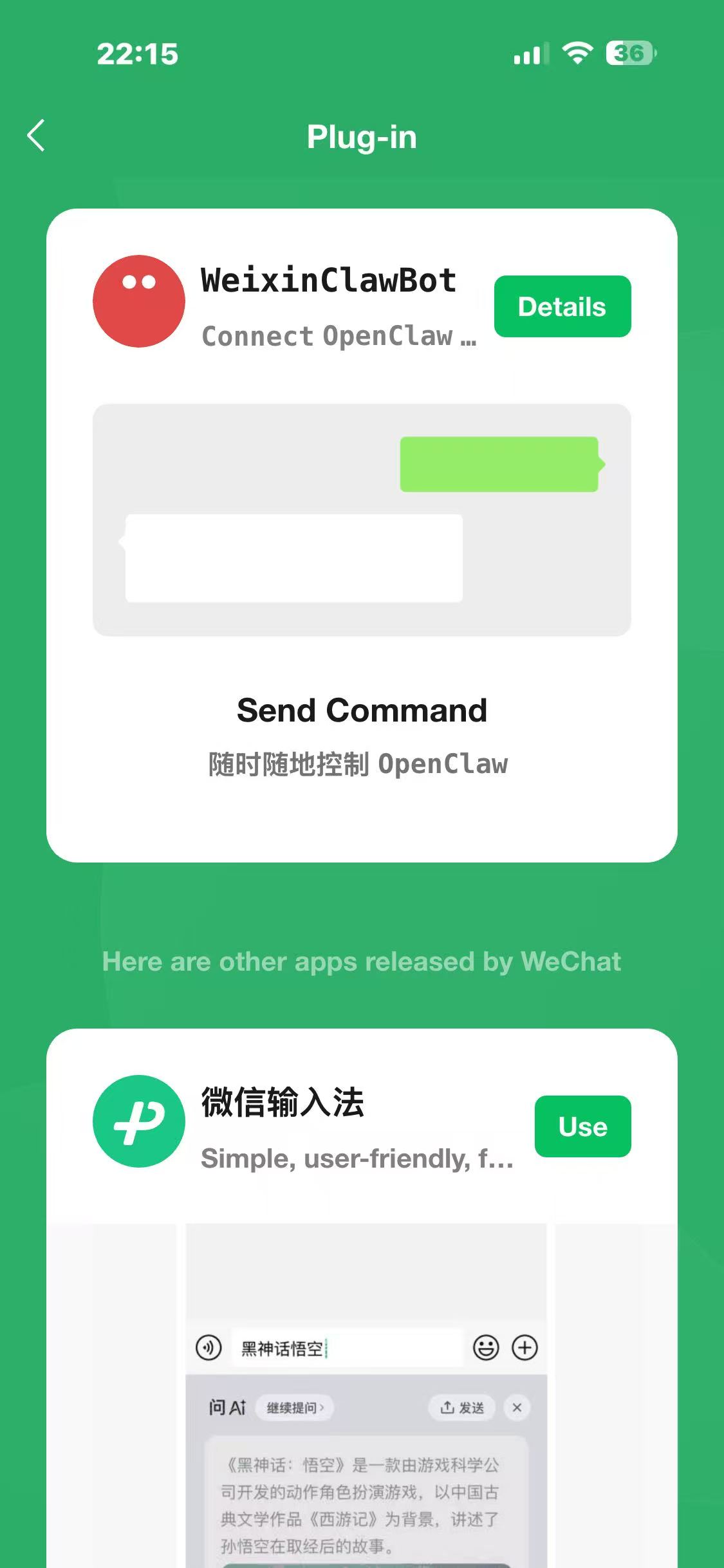
WeixinClawBot shown in WeChat’s plug-in screen. It connects to an OpenClaw agent inside the existing WeChat interface, with no separate app to install.
2. ClawBot: an agent that arrives as a contact
On 22 March 2026 Reuters reported that Tencent had launched ClawBot, connecting the WeChat messaging platform to the OpenClaw AI agent. ClawBot appears inside WeChat as a contact, and users interact with OpenClaw directly through the messaging interface.
What is interesting here is the distribution method rather than the capability. Many agent services require installing a new app, creating a separate account, learning a new interface. ClawBot uses the WeChat conversation interface people already know.
OpenClaw is presented as an open-source agent capable of automation tasks such as transferring files and sending email. On the reporting currently available, though, it is hard to say ClawBot has fully wired every WeChat mini program into payment, booking and purchase. The safer reading is that a conversational touchpoint to an AI agent now exists inside WeChat.
Which is to say: the significance of ClawBot is not that WeChat shipped finished AI commerce. It is that WeChat has begun putting an agent into the contact list and the conversational habits of its users.
3. Mini programs go AI: the ecosystem is the real weapon
WeChat’s real strength is not one agent but the mini program ecosystem that agent can connect to. A WeChat mini program works like an app inside the app. Users order food, shop, buy tickets, play games, use daily services and consume content without installing anything.
That structure fits an agent well. Once the AI has understood a request, the next step is calling the right service. WeChat already has enormous numbers of mini programs plus WeChat Pay, official accounts, group chats and Mini Shops as service touchpoints.
In January 2026 WeChat announced a growth plan for AI application and online tool mini programs. It includes cloud development environment support for new developers, connections to large models, data analysis tooling, commercialisation support and traffic incentives. Reporting mentioned up to 100 million Hunyuan text model tokens and 10,000 text-to-image model resources per developer.
The direction matters more than the free tokens. Tencent is putting Hunyuan inside the WeChat mini program development flow, steering developers to build AI features within the WeChat ecosystem. It is closer to an attempt to bind model, cloud, mini program, payments and traffic into a single developer experience.
There is no need to over-read this part, though. Hunyuan token support does not by itself guarantee the ecosystem’s success. How many developers actually participate, whether Hunyuan’s quality is sufficient against competing models, and whether AI features inside mini programs give users durable value all remain to be verified.
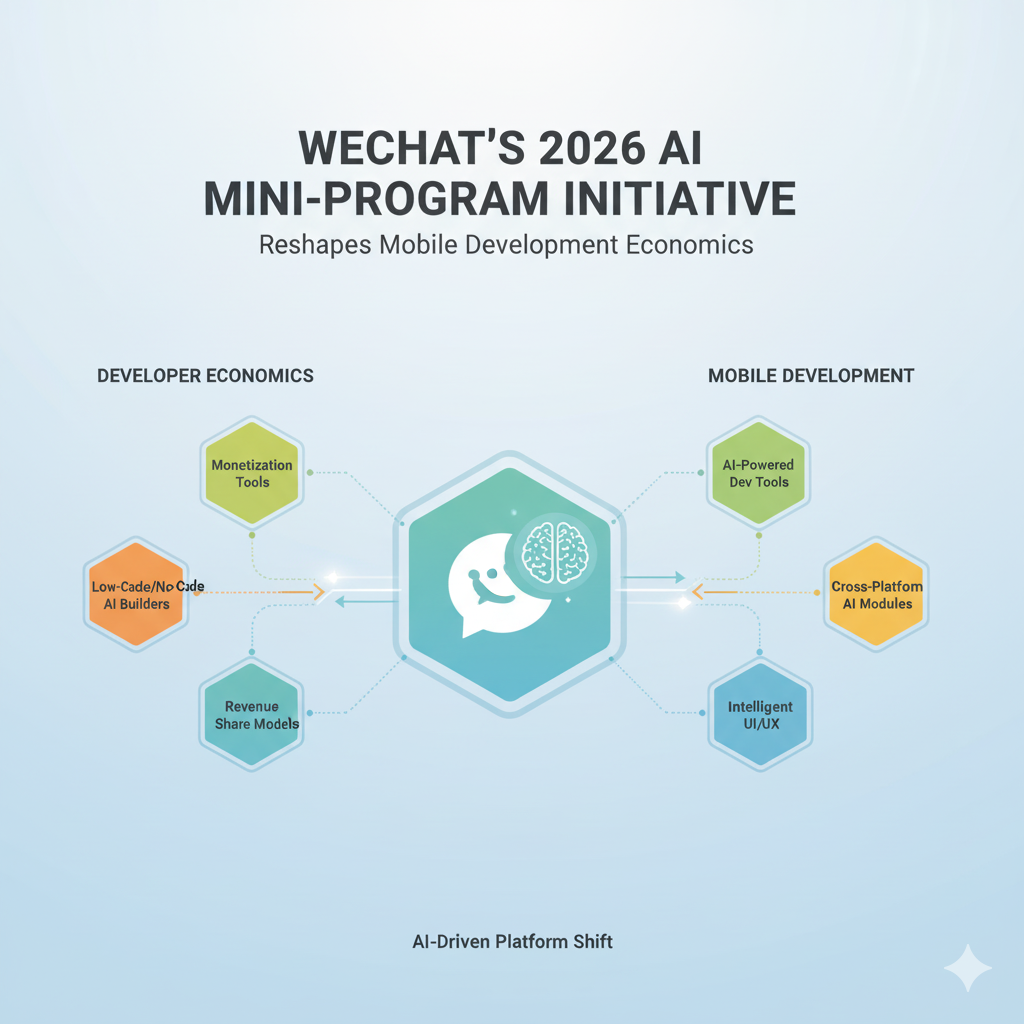
A conceptual view of the initiative, expanding through developer economics, monetisation tools, AI dev tools, cross-platform modules and intelligent UI/UX.
4. iOS mini app payments: some monetisation friction eases
A quiet but important change in WeChat’s AI strategy is the iOS mini app payment environment.
In November 2025 Apple announced the Mini Apps Partner Program. Where a host app for mini apps meets certain conditions, eligible in-app purchases within those mini apps qualify for a reduced 15% commission. Apple described it as support for self-contained mini apps built with HTML5 and JavaScript.
According to The Verge and Bloomberg, the change connects to WeChat mini app payments, with reporting that Apple and Tencent reached an agreement applying the 15% rate to WeChat mini app purchases.
This too warrants care. It does not mean every iOS payment in WeChat mini programs opened up freely. Apple’s programme presupposes specific requirements: eligible in-app purchases, the Advanced Commerce API, age range APIs. The more accurate reading is that some of the friction around monetising mini-program-based digital goods and services on iOS has eased.
From an agent perspective the change matters. For an agent to recommend or call paid content, tools, subscriptions and digital services inside a mini program, the payment flow cannot be blocked. Easing iOS monetisation friction gives developers experimenting with AI features inside WeChat mini programs a more realistic revenue path.
5. The strategy: conversational infrastructure, not payment infrastructure
Alipay and WeChat start their AI strategies from different places.
Alipay is a payment and settlement platform. AI付 lets a user pay through an agent; AI收 lets developers and merchants collect per AI call. Alipay’s core is the payment and collection rails of the AI era.
WeChat’s core is the daily-life touchpoint where conversation, relationships, groups, mini programs and WeChat Pay combine. WeChat is putting an agent into the space users already occupy, and exploring the possibility that the agent leads onward into mini programs and services when needed.
| Alipay | WeChat/Weixin | |
|---|---|---|
| Starting point | payment, collection, settlement | conversation, relationships, mini programs |
| Core capabilities | AI付, AI收, Token Pay, AI Wallet | ClawBot, AI in mini programs, Hunyuan support |
| Strength | closed payment loop, financial infrastructure | vast MAU, social graph, service touchpoints |
| Developer draw | per-call collection, payment integration | model tokens, cloud, traffic, mini programs |
| Current limit | conversational touchpoints are relatively weak | no clear standalone AI collection protocol yet |
The difference matters from a data perspective too. Alipay’s strong data is closer to transactions and payment intent. WeChat’s strong data is closer to conversation, relationships, sharing and group context.
In an agent era, why someone went looking for a service, who they discussed it with, and in what context they asked may matter as much as what they bought. On that measure WeChat is less a payment app than the top of the AI commerce funnel, the space where intent originates.
A supporting image for the strategic split: “Alipay of payment infrastructure” versus “WeChat of conversational and social infrastructure.”
6. The strengths and limits in numbers
WeChat’s largest strength is scale and touchpoints. Tencent’s Q1 2026 results put combined Weixin/WeChat MAU at 1.432 billion. Tencent also described improvements to AI-based ad recommendation models inside the Weixin ecosystem and rapid GMV growth at Mini Shops.
Which is to say WeChat is not a plain messenger but a composite platform connecting advertising, commerce, payments, content and mini programs. An agent entering a platform like that has room to carry a request beyond a plain answer into an actual service call.
The limits are equally clear.
First, WeChat has not yet shown a distinct brand or protocol putting AI payment and AI collection front and centre the way Alipay’s AI付 and AI收 do. What is confirmable now is closer to the ClawBot integration, AI support in mini programs, and the iOS mini app payment change.
Second, how strong Hunyuan and Tencent’s agent products actually are in user experience needs watching. Tencent mentioned early results for the Hy3 preview model and productivity agents such as WorkBuddy in its Q1 2026 results, but that is the company’s own assessment; long-run performance in the open market still needs confirmation.
Third, because agents handle sensitive areas (messages, files, email, payments), security and privacy questions follow. Reuters also reported that authorities are warning about security risks as agent products like OpenClaw spread.
7. A personal view: Tencent is taking the touchpoint before the technology
The most interesting thing about WeChat’s strategy is that Tencent is not pushing AI only as a standalone app. Instead it puts the agent inside the existing super app, gives mini program developers model and cloud resources, and works the iOS monetisation change to its advantage.
That is a different approach from “build the best model first.” Tencent has the space users already occupy and the channel developers already publish to. Provided AI performance clears some threshold, WeChat’s distribution is a formidable weapon.
But that alone does not guarantee success. An agent demands far more trust than a plain chatbot. Misread a request, call the wrong mini program, or fail somewhere in payment, booking or purchase, and users lose confidence fast.
So WeChat’s decisive ground is not how many users see AI, but how safely and naturally it designs the moment where conversation turns into execution.
8. WeChat could be the other entrance to AI commerce
On the facts currently confirmable, it is hard to say WeChat immediately displaces Alipay’s AI payment infrastructure. Alipay has put forward structures aimed squarely at paying and collecting: AI付, AI收, Token Pay and AI Wallet. WeChat is at the stage of widening agent touchpoints through the ClawBot integration, AI support in mini programs, Hunyuan resources and the iOS mini app payment change.
WeChat’s strength is not one payment feature, though. A structure combining roughly 1.4 billion MAU with a conversational interface, mini programs, WeChat Pay, official accounts and group chats is a good environment for an agent to enter daily life.
TechNode, citing The Information, reported that Tencent is developing a separate agent project connected to the WeChat mini program ecosystem, with mention of graybox testing around mid-2026 and possible expansion in Q3. This is reporting rather than an official launch announcement, so schedule and scope may change.
The safest reading at this stage: Alipay is showing the financial infrastructure by which AI pays and collects, and WeChat is building the touchpoint at which AI enters a user’s conversation and daily service flow.
The next round of AI commerce is unlikely to unfold as one side winning outright. More likely, payment infrastructure and conversational infrastructure push the agent economy from different directions, and new experiences and revenue models emerge where they meet.
Which leaves one question.
Where does user intent originate, and which payment and collection infrastructure does that intent connect to?
Alipay starts from payment; WeChat starts from conversation. Which is stronger is not yet decidable. But it does look clear that commerce in the agent era is turning from a contest of good chatbots into a contest over the link between where intent originates and where payment executes.
Keywords
WeixinClawBot, OpenClaw, Hunyuan, Tencent AI Agent, WeChat Mini-Program AI Growth Plan, Mini Apps Partner Program, WeChat Pay, Alipay AI付, AI收, Agentic Commerce
References
- Tencent Announces 2026 First Quarter Results (PR Newswire)
- Tencent integrates WeChat with OpenClaw AI agent amid China tech battle (Reuters)
- WeChat Launches AI Mini Program Growth Program (AIBase)
- Introducing the App Store Mini Apps Partner Program (Apple Developer)
- Apple will take a mini commission from mini app developers (The Verge)
- Tencent 2026 Q1 Earnings Release (Tencent, PDF)
- Tencent is said to be developing a top-secret AI agent project for WeChat (TechNode)
Written as of 26 May 2026 from public reporting and company announcements. Some figures come from Tencent, WeChat or press material and may not be independently verified industry statistics. WeChat’s separate agent project and the eventual scope of mini program integration in particular are reporting-based, so actual timelines and features may change.
Related posts: